Tuesday, February 3, 2026
This Was Agnes St.: Remembering Place, Community, and Responsibility
Do you know what used to be on the land where our Campus Center is built? University Boulevard, where the Campus Center is located, used to be Agnes St. At 458/460 Agnes St. stood a two-story building and an outhouse where generations of Hoosiers lived. They knew it as The House on the Corner. Today, our Campus Center stands in its place.
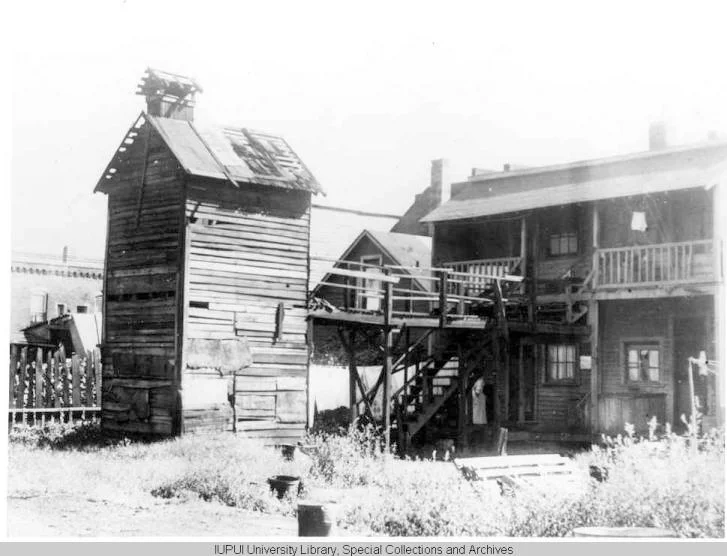
As we mark Black History Month in February, we are invited to reflect on how our history is shaped by people, places, and purpose. One way our campus is engaging in that reflection is through This Was Agnes St., an exhibit currently on display in the Cultural Arts Gallery on the first floor of the Campus Center. From the mid-19th century through much of the 20th century, Agnes St. was home to generations of residents—immigrants, working-class families, Black veterans, entrepreneurs, and caregivers—who started families, ran their businesses, and built their community on Agnes St. By the late 1960s and early 1970s, the neighborhood was displaced by IUPUI, and Agnes St. was renamed University Boulevard.
From the fifth floor of University Hall, where the Chancellor’s Office is located, the view looks out over the Campus Center and the ground beneath it—a reminder of the families who once lived, worked, and contributed to our history at the House on the Corner. Though the landscape has changed, the history remains present beneath our feet, calling us to remember those who came before us and the legacy that shapes the place we now call IU Indianapolis.
Our understanding of Agnes Street today is shaped in part by scholarship led by faculty and students from our campus, including archaeological fieldwork conducted in the early 2000s by Paul Mullins and his students. This Was Agnes St. exhibit reflects the work of many contributors, including faculty, students, staff, and community members, with curatorial leadership from Laura Holzman, professor of art history and museum studies. The exhibit also features a contemporary interpretation by artist, educator, and 2022 graduate of the Kelley School of Business Indianapolis, Zola Lamothe, through her work, Unveiling a Forgotten Legacy.
With pride in our place, and with gratitude in our hearts, we remind ourselves that universities are grounded in communities and their histories. As we work to serve all who call our city and region their home, we must never lose sight of our origins.
As researchers and educators, we have a responsibility to ensure that this history is explored, preserved, and shared with those who learn and work on our campus. How do we ensure that every student, staff member, and faculty colleague who comes to IU Indianapolis learns about this history? How do we preserve the stories of who we are and where we came from?
I encourage you to visit the exhibit, engage with its stories, and reflect on how place, history, and community continue to shape the work we do at IU Indianapolis.
Go Jags!
Latha Ramchand
Chancellor